How to Build a Fairy-Tale Outdoor Garden That Feels Like Magic
Every garden has the potential to become a place of enchantment. It does not matter whether you are working with a vast rolling acre or a narrow city balcony — the principles of whimsical garden design are scale-able, endlessly adaptable, and rooted in something that no landscaping budget can purchase outright: imagination. This guide will walk you through the process of transforming your outdoor space, step by step, into the kind of garden that makes visitors gasp softly when they first pass through the gate. The kind of garden where you half-expect to hear the distant sound of fairy bells, where the morning light through dewdrops feels genuinely miraculous, and where the act of sitting quietly with a cup of tea becomes a ceremony.
We will cover everything from the bones of the space — pathways, structures, and water features — to the fine jewelry of the garden: the lighting, the miniature details, the hidden discoveries that reward the curious walker. Let us begin at the beginning: the gate.
Step 1: Design a Gateway That Sets the Mood Instantly
The entrance to a whimsical garden is not merely a functional threshold — it is the opening line of a story. Before a single plant is placed or a single lantern hung, the gate and its surrounding archway must communicate, immediately and unmistakably, that what lies beyond is different from the ordinary world.
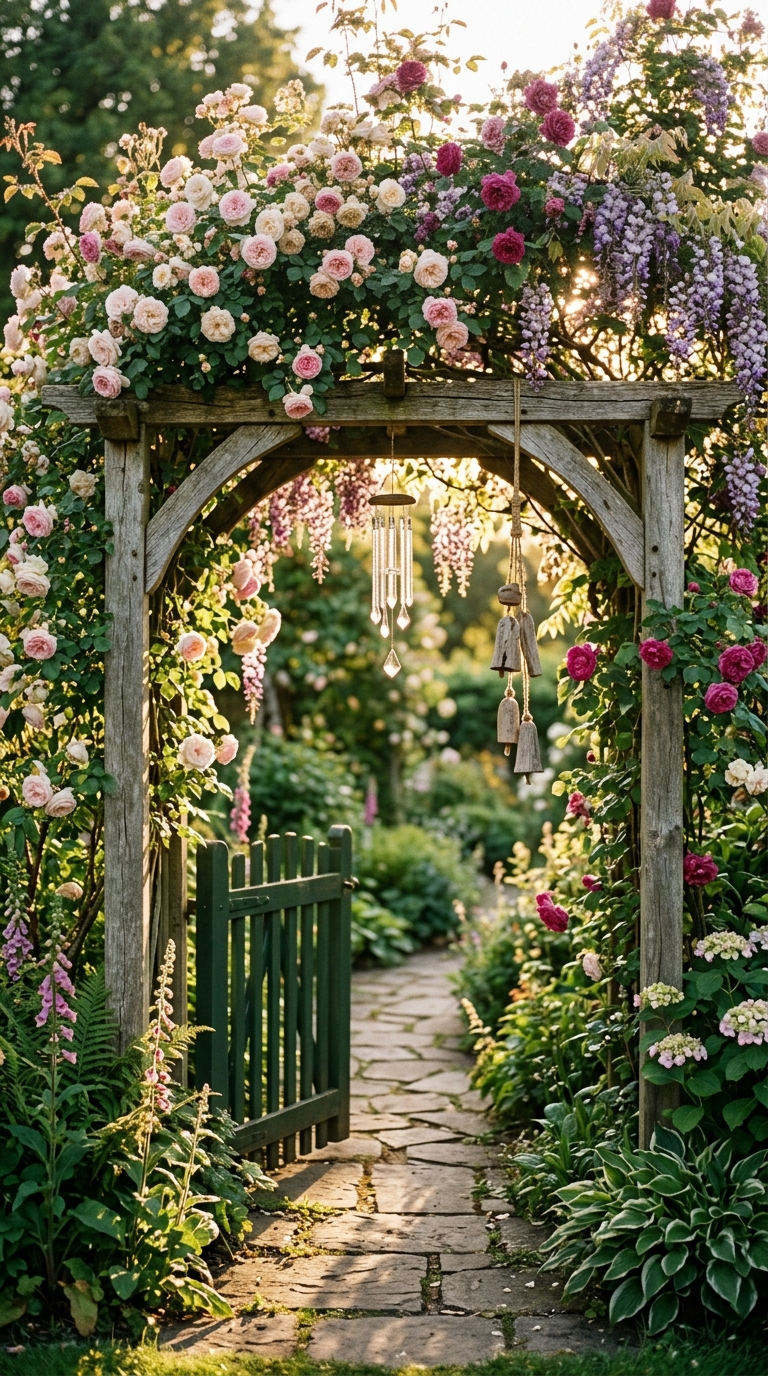
Consider building a moon gate from stacked natural stone or cast concrete — a perfectly circular arch framing the view of the garden beyond, its interior edge planted with creeping thyme or elfin herbs that soften the stone with living green. Alternatively, construct a rustic timber archway and train climbing roses, wisteria, or passionflower across its frame. Over two or three seasons, the plants will engulf the structure entirely, creating a living tunnel of bloom and fragrance that changes with every month of the year.
Add hanging wind chimes crafted from reclaimed silverware, small driftwood pieces, and crystal drops at the threshold. Their sound will announce arrival in the most magical possible way. Paint the gate itself in an unexpected color — deep forest green, dusty violet, or sun-bleached turquoise — that immediately signals departure from the prosaic world beyond.
Step 2: Lay a Pathway That Invites Wandering
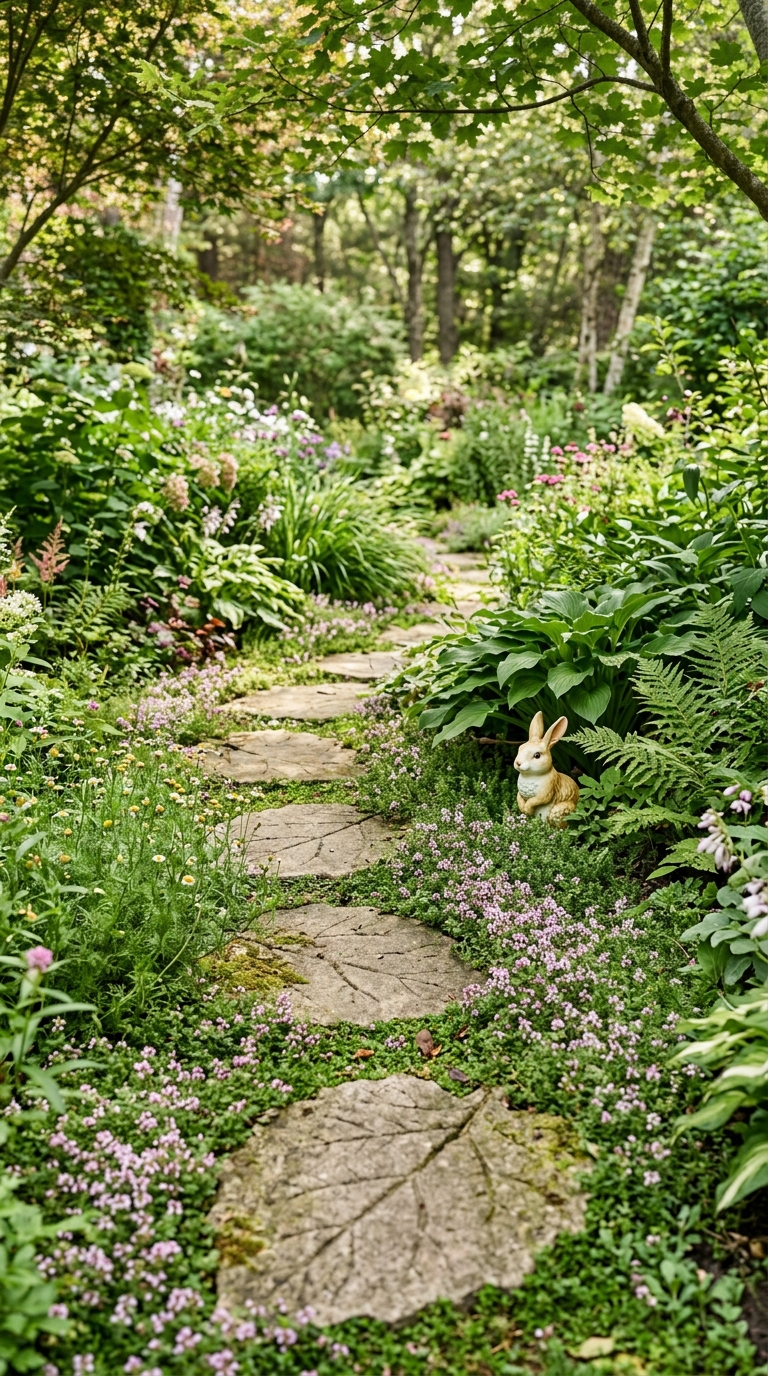
A straight path is efficient. A winding path is an adventure. In a whimsical garden, pathways should meander with apparent purposelessness, leading the walker past new discoveries at every bend and encouraging a pace of gentle, unhurried exploration. Use materials that carry their own stories: reclaimed cobblestones with moss growing in their joints, stepping stones cast in the shapes of oversized leaves, raw-cut timber rounds set at intervals through a sea of creeping ground cover.
Between the stepping stones, allow low-growing plants to establish freely — chamomile, which releases its apple scent when stepped on, or creeping thyme that turns the path edges into a purple-flowered ribbon in summer. Tuck small decorative elements along the path edges: a ceramic rabbit half-hidden in foliage, a tiny painted sign pointing toward invented destinations, a cluster of handmade mosaic stepping stones with inlaid colored glass that gleams in wet weather.
Step 3: Build a Whimsical Garden Structure as a Focal Point
Every truly enchanting garden has a structure that anchors it — a place to sit, to dream, and to feel contained by beauty. The conventional choices are gazebos and pergolas, but the whimsical garden calls for something more inventive. Consider these extraordinary alternatives:
The Hobbit Nook: A low, rounded structure built into a gentle slope or raised earth berm, its roof planted with sedum and wildflowers, its circular door painted in deep red or cobalt blue, its interior just large enough for a bench, a lantern, and the feeling of being perfectly hidden from the world. This is the retreat that calls you back even on busy days.
The Teapot Gazebo: A playful structure whose silhouette takes visual cues from the classic form of a teapot — a curved, overhanging roof suggesting the pot’s body, a spiraling weathervane as the spout, decorative lattice panels in the shape of the handle. Plant the surrounding area with herbs traditionally associated with tea-making: lemon verbena, chamomile, peppermint, rose hips. The structure becomes both art and sensory garden in one.
The Tree House Nook: Even without a true tree house, the suggestion of one — a small elevated platform built around the trunk of a mature tree, accessed by two or three natural log steps, surrounded by a simple railing woven from living willow — creates a magical elevated vantage point that transforms the whole garden below.
Step 4: Create Enchanting Water Features That Shimmer and Sing
Water is the single most transformative element available to the garden designer. It introduces sound, movement, reflection, and life — the four qualities that make a garden feel animated rather than static. In a whimsical garden, water features should feel discovered rather than installed.
A naturalistic pond with gently sloping banks, surrounded by moisture-loving irises, ferns, and primulas, with flat stepping stones extending into its shallows and a small island planted with a single weeping dwarf willow, has the quality of a place that has always been there, waiting to be found. Install a small recirculating pump to create the gentlest possible surface movement and the sound of water whispering over smooth pebbles at its edge.

For smaller spaces, a repurposed antique vessel — a stone trough, a large glazed ceramic urn, an old cast-iron bath — filled with still water and planted with a miniature water lily and a few floating candles becomes a pocket garden unto itself. Tuck it into a corner surrounded by tall ornamental grasses and it becomes a hidden discovery, found only by the walker who ventures off the main path.
Do not overlook wall fountains: a carved stone face or a decorative ceramic mask mounted on a garden wall, trickling water from its mouth into a shallow basin below, combines sculpture and water feature in one compact installation that punches far above its physical size in terms of atmosphere and character.
Step 5: Plant for Story, Texture, and Seasonal Magic
Planting in a whimsical garden is less about horticultural correctness and more about narrative. Each planting area should feel like a chapter: the wild meadow section where grasses and self-seeding annuals mingle in beautiful disorder; the secret sunken garden enclosed by tall hedges where the air is still and heavy with fragrance; the moonlit white garden that comes alive after dark, its pale flowers and silver-leaved plants glowing in the dusk.
Choose plants that carry their own mythology and poetry. Foxgloves for their fairy-finger flowers and their association with the folk tradition of little people. Alliums for their perfectly spherical flower heads that seem almost too geometric to be natural. Cleome for its spider-like flowers that hover above ferny foliage on tall, ethereal stems. Angel’s trumpets for their enormous pendant blooms that perfume the evening air with a heady, tropical sweetness.
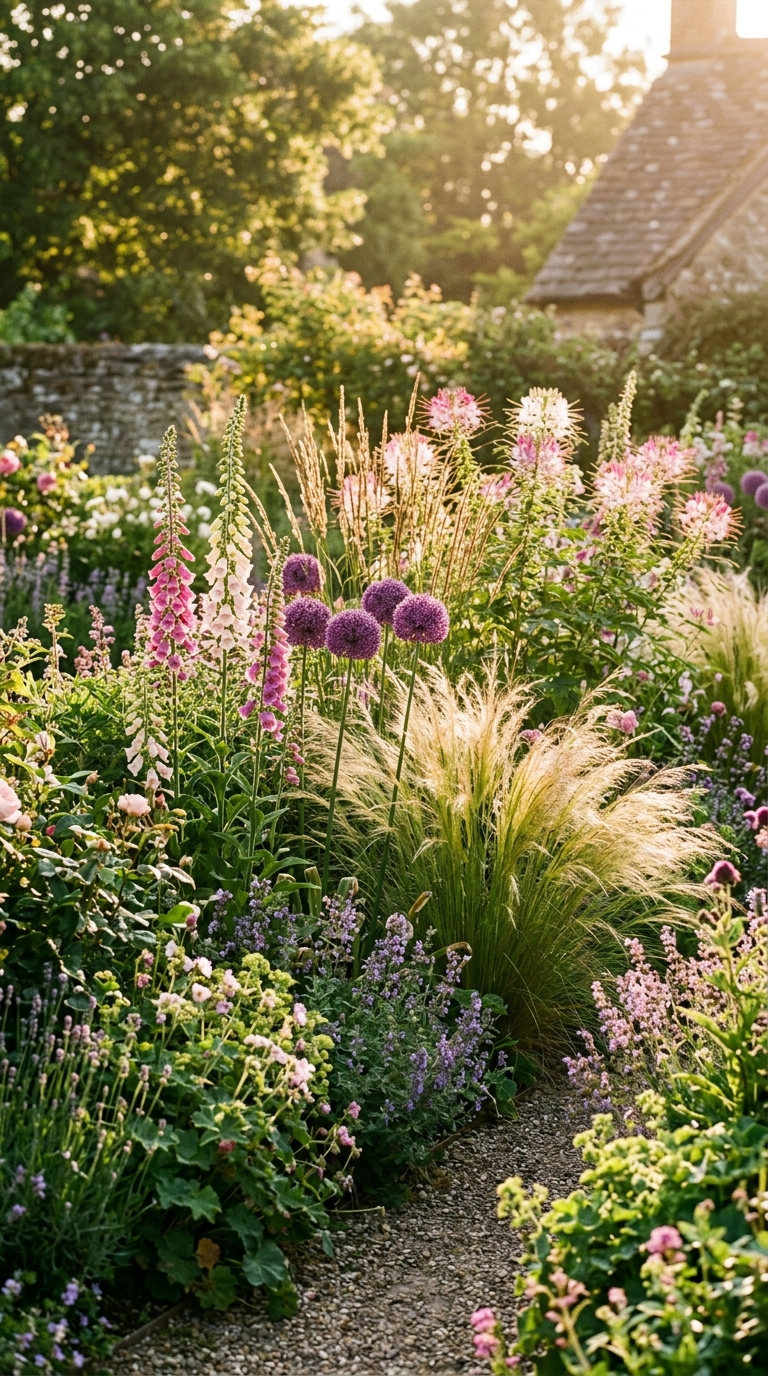
Allow generous self-seeding throughout the garden. The plants that choose their own locations — a foxglove establishing itself in the crack of a dry stone wall, a Welsh poppy colonizing the base of a mossy step — always look more natural and magical than those planted with deliberate precision. Learn to recognize the seedlings of your favorite self-seeders and resist the urge to weed them out.
Step 6: Illuminate the Garden for Nocturnal Enchantment
A whimsical garden at dusk and after dark is a completely different world from its daytime self — and with thoughtful lighting, it can be the more magical of the two. The guiding principle of whimsical garden lighting is this: never use bright, harsh, utilitarian light sources. Every light in an enchanting garden should feel like it belongs to the garden itself, as if the plants and stones are generating their own gentle luminescence.
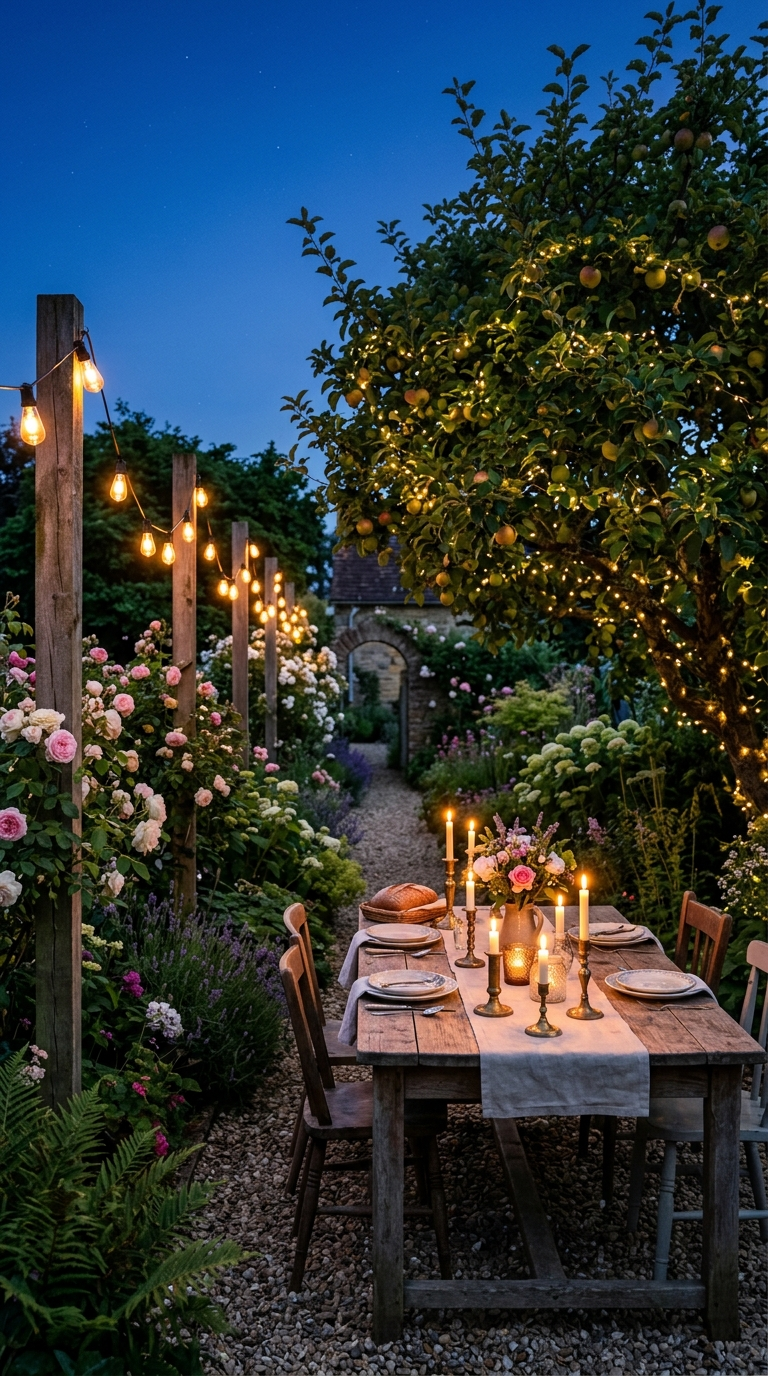
Solar-powered micro LED fairy lights woven through the branches of trees and shrubs create the appearance of a garden full of fireflies. Vintage-style Edison bulb string lights draped in loose festoons between fence posts or along the eaves of a garden structure add a warm, carnival romance. Handmade paper lanterns hung from branches — weighted inside with battery-powered tea lights — sway in the breeze like luminescent seed pods.
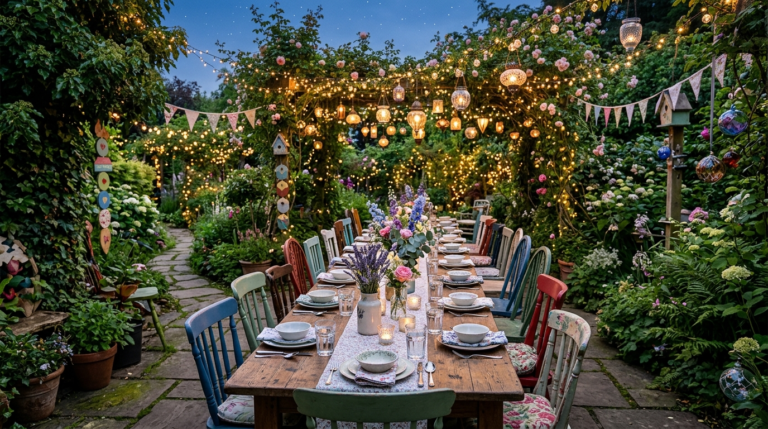
For pathways, use small stake lights with warm amber bulbs set at ground level rather than elevated posts — the light they cast illuminates only the path itself, leaving the surrounding planting in romantic semi-darkness. Place a few uplights at the base of particularly beautiful trees to cast dramatic leaf-shadow patterns across walls and fences. And do not forget candles: an outdoor dining table laden with mismatched candlesticks in varying heights is one of the most timelessly romantic garden lighting choices available.
Step 7: Add the Tiny Details That Create Wonder
It is the small, unexpected details that elevate a beautiful garden into a genuinely enchanted one. These are the elements that reward slow, attentive exploration — the discoveries that make a child’s eyes widen and an adult pause and smile with a sudden, unguarded delight.
Install a miniature fairy garden within a large old hollow log or a mossy stone trough: tiny houses crafted from acorn caps and bark, miniature furniture made from lolly sticks and walnut shells, a path of crushed eggshell winding between thumb-sized planted herbs. Leave small notes tucked into the scene suggesting the fairy inhabitants have only just stepped away.
Hang a collection of vintage keys from a garden tree, each on a different length of weather-resistant twine, as if the tree is the keeper of many forgotten locks. Create a wishing well from a terracotta chimney pot filled with pebbles and topped with a miniature pitched roof crafted from copper flashing. Paint a bee hotel in stripes of honey gold and mount it on a fence post surrounded by lavender and single-flowered roses whose pollen-rich centers provide the perfect welcome.
Place a large flat stone in a quiet corner inscribed with nothing but a question mark — the most open-ended and whimsical of all garden markers, inviting the visitor to supply their own answer.
Step 8: Maintain the Magic Through the Seasons
A whimsical garden is not a static installation but a living, evolving story. Part of its enchantment lies in the way it changes — the way the bare winter skeleton of a climbing rose becomes a tracery of frost, the way the autumn garden fills with the amber and copper warmth of turning leaves, the way even the sleeping winter garden holds a particular quiet magic in its structure of seed heads and skeletal stems.
Resist the urge to cut everything back in autumn. Leave the ornamental grass plumes standing for winter interest. Keep the seed heads of alliums, teasels, and echinacea for the birds and for the way they hold frost and dew in their architectural forms. Add winter-flowering plants — hellebores, witch hazel, winter jasmine, snowdrops — to ensure the garden has something to offer in even the coldest months.

Change your decorative elements with the seasons too. Swap the summer fairy lights for warm copper lanterns in autumn. Replace potted summer annuals with containers of jewel-toned ornamental kale, trailing ivy, and clusters of berried branches. Hang a simple bird feeder in a prominent position and let the visitors it attracts become part of the garden’s living art. A garden that changes with the seasons is a garden that can be discovered anew every single month of the year — and that is perhaps the most magical quality of all.
Your fairy-tale garden is not a destination you arrive at fully formed one morning. It is a practice, a conversation between you and the land, a story you add to chapter by chapter across the seasons and the years. Begin with one step — one gate, one path, one water feature — and trust that the magic will grow from there, one discovery at a time.